
The Magic of Bengali Onomatopoeia: How “Sound Words” Bring the Language to Life

Have you ever listened to native Bengali speakers and noticed rhythmic, musical pairs of words rolling off their tongues? Words like jhom-jhom, musholdhare, or jhor-jhor?
These are called Bengali Onomatopoeia.
Take a look at this evocative line from Bengali literature:
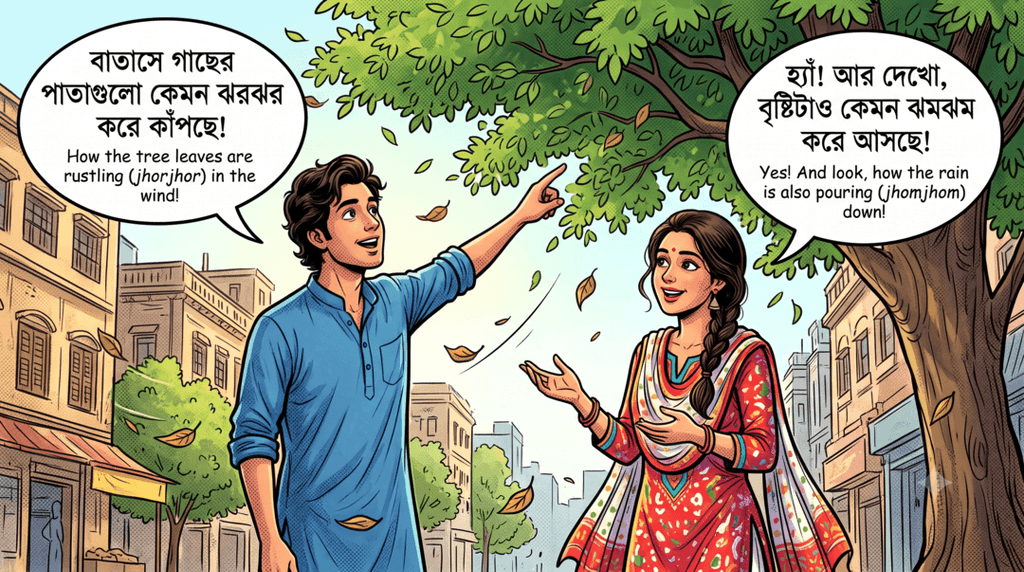
গাছের পাতা ঝরঝর করে কাঁপছিল।
(Gāchher pātā jhorjhor kore kāpchhilo.)
Translation: “The leaves of the tree were trembling with a rustling, fluttering sound.”
At first glance, an English translation might use standard adverbs like “rapidly” or “loudly.” But in Bengali, the word ঝরঝর (Jhorjhor) does something far more vivid: it doesn’t merely describe the action—it lets you hear the dry rustle of the foliage and feel the sudden draft of wind shaking the branches.
These captivating expressions belong to a unique grammatical family known as ধন্যাত্মক শব্দ (Dhonyātmok Shobdo) or অনুকরণ অব্যয় (Onukoron Obbyoy)—Bengali onomatopoeic words, ideophones, and sensory reduplications.
If you want to move past textbook sentences and truly sound like a native speaker, mastering this linguistic superpower is your ultimate shortcut. In this guide, we’ll break down what these words are, how they function, and the most common ones you can start using today.
What Are Dhonyātmok Shobdo (Bengali Ideophones)?
In English, onomatopoeia is usually limited to simple sound-imitations: buzz, splash, boom, or tick-tock.
Bengali takes this concept several steps further. Dhonyātmok Shobdo are sensory words—often formed by repeating a root syllable (reduplication)—that depict not just sounds, but physical sensations, emotional states, visual motions, textures, and atmospheres.
They are the soul of everyday spoken Bengali and classical poetry alike. Without them, the language feels flat and mechanical; with them, your sentences transform into living, breathing imagery.
How to Use Them in a Sentence
Most of these reduplicative words act as adverbs modifying a verb. In everyday speech, they are frequently paired with the participle করে (kore), meaning “doing” or “with the manner of”: Sensory Word + করে (kore) + Verb
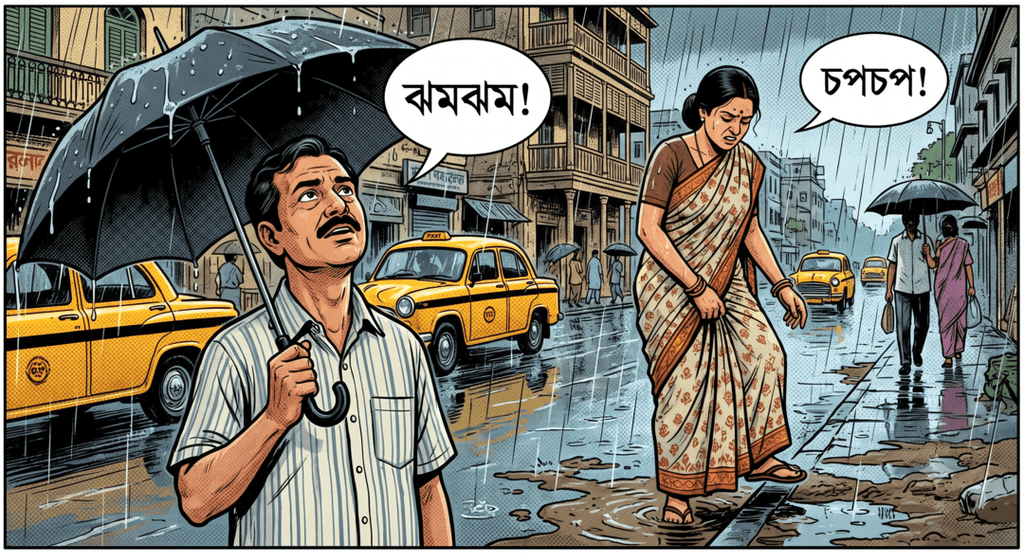
- ঝমঝম (Jhomjhom) + করে (kore) + বৃষ্টি পড়ছে (brishti porchhe) = Rain is pouring down with a heavy, drumming rhythm.
Decoding “ঝরঝর” (Jhorjhor): A Multi-Sensory Chameleon
To see how nuanced these words can be, let’s revisit ঝরঝর (Jhorjhor) from our opening example. Depending on the context, this single word can evoke three distinct sensory impressions:
1. Rustling and Shivering (Auditory & Visual)
As shown in our example sentence, when applied to foliage, light fabrics, or delicate objects in a breeze, it captures the dry, continuous flutter:
- বাতাসে পর্দাটা ঝরঝর করে কাঁপছে।(Batāshe pordāta jhorjhor kore kāpchhe.)“The curtain is fluttering and rustling in the breeze.”
2. Streaming Tears or Pouring Water (Fluid Motion)
When describing water or crying, jhorjhor mimics the effortless cascade of liquid:
- মেয়েটির চোখ দিয়ে ঝরঝর করে জল পড়ছিল।(Meyetir chokh diye jhorjhor kore jol porchhilo.)“Tears were streaming copiously down the girl’s face.”
3. Lightness, Freshness, and Texture (Physical Sensation)
In colloquial Bengali, the adjectival form ঝরঝরে (jhorjhore) describes well-separated, perfectly cooked grains of rice (not sticky or mushy). It can also describe waking up feeling totally refreshed after deep rest:
- এক কাপ চা খেয়ে শরীরটা বেশ ঝরঝরে লাগছে।(Ek kap cha kheye shorirta besh jhorjhore lagchhe.)“After a cup of tea, my body feels wonderfully light and refreshed.”
💡 Ready to Go Beyond Rote Vocabulary?
Learning grammar charts and static vocabulary lists from an app can only take you so far—real fluency is about feeling the rhythm, natural melody, and cultural subtleties of everyday speech. Why struggle through confusing translations on your own when a dedicated mentor can guide you? Contact us at LearnBengaliOnline today to book your personalized 1-on-1 trial lesson, and start speaking with true native confidence from day one!
Essential Bengali Sensory Words to Elevate Your Bengali
Here is a curated glossary of the most expressive and practical Dhonyātmok Shobdo categorized by how native speakers use them daily.
1. Weather and Nature Sounds
- ঝমঝম (Jhomjhom) – Torrential, Drumming Rain. Bengali has countless words for rain, but jhomjhom is the king of monsoon vocabulary. It evokes heavy raindrops crashing against tin roofs or pavements.
- Example: বাইরে ঝমঝম করে বৃষ্টি নামল।(Bāire jhomjhom kore brishti nāmlo.)“Outside, rain poured down in a roaring torrent.”
- শনশন (Shonshon) – Whistling, Gusty Wind. Describes cold, piercing, or rapid winds slicing through winter air or a cyclone.
- Example: জানালা দিয়ে শনশন করে কনকনে ঠান্ডা হাওয়া আসছে।(Jānālā diye shonshon kore konkone thāndā hāwā āshchhe.)“A freezing gust of wind is whistling through the window.”
- কলকল (Kolkol) – Babbling, Gurgling Streams. The peaceful, melodic flow of a fresh river, brook, or fountain.
- Example: পাহাড়ি ঝরনাটি কলকল ধ্বনিতে বয়ে চলেছে।(Pāhāri jhornāti kolkol dhvonite boye cholechhe.)“The mountain brook flows by with a gentle, babbling murmur.”
- মরমর (Mormor) – Snapping, Crunching Dry Leaves. The brittle sound made when stepping on dry autumn leaves or cracking dry twigs.
- Example: শুকনো পাতার ওপর দিয়ে হাঁটতেই মরমর শব্দ হলো।(Shukno pātār opor diye hānt-tei mormor shobdo holo.)“A dry crunching sound echoed as someone walked across the fallen leaves.”
2. Physical and Emotional Sensations
- থরথর (Thorthor) – Intense Shivering or Trembling. Used when a person or creature shakes uncontrollably due to intense winter cold, terror, or acute shock.
- Example: ভয়ে ছেলেটি থরথর করে কাঁপতে লাগল।(Bhoye chheleti thorthor kore kānpte lāglo.)“The boy began to tremble violently out of sheer fear.”
- ধুকপুক (Dhukpuk) – Palpitating, Thumping Heart. The physical sensation of your heart racing due to suspense, exercise, or anxiety.
- Example: পরীক্ষার ফল বেরোনোর আগে বুকটা ধুকপুক করছিল।(Porikkhār fol beronor āge bukta dhukpuk korchhilo.)“My heart was pounding with nervous anticipation before the exam results were announced.”
- খালি-খালি (Khāli-khāli) – An Unsettling Emptiness. A feeling of hollow loneliness when someone close departs.
- Example: বন্ধুরা চলে যাওয়ার পর বাড়িটা কেমন খালি-খালি লাগছে।(Bondhurā chole jāowār por bāritā kemon khāli-khāli lāgchhe.)“The house feels so strangely hollow and quiet after the friends left.”
3. Tactile and Visual Descriptors
- টুপটুপ (Tuptup) – Gentle, Rhythmic Dropping. Describes light droplets falling softly, or small fragrant blossoms falling off trees in the early morning.
- Example: শিউলি ফুলগুলো ঘাসের ওপর টুপটুপ করে ঝরে পড়ছে।(Shiuli phulgulo ghāser opor tuptup kore jhore porchhe.)“Shiuli blossoms are dropping softly, one by one, upon the morning grass.”
- চকচক (Chokchok) – Gleaming, Sparkling Surface. Used for polished surfaces, clean glassware, jewelry, or bright eyes glistening with joy.
- Example: পরিষ্কার করার পর মেঝেটা আয়নার মতো চকচক করছে।(Porishkār korār por mejhetā āynār moto chokchok korchhe.)“After cleaning, the floor is sparkling clean like a mirror.”
- হুটহাট (Huthāt) – Sudden, Impulsive Actions. Describes making decisions or showing up abruptly without prior planning.
- Example: এভাবে হুটহাট সিদ্ধান্ত নেওয়া ঠিক নয়।(Ebhābe huthāt shiddhānto neowā thik noy.)“Making reckless, impulsive decisions like this is never a good idea.”
Comparison Table: Common Bengali Sensory Duos
| Bengali Word | Transliteration | Core Sensory Trigger | Typical Context |
| ঝরঝর | Jhorjhor | Rustling, flowing, lightness | Fluttering leaves, flowing tears, fluffy rice |
| ঝমঝম | Jhomjhom | Heavy rhythmic percussion | Torrential rain, ringing ankle bells (ghungroo) |
| শনশন | Shonshon | Whistling, whooshing velocity | Fast chilly wind, arrow whistling through air |
| থরথর | Thorthor | Rapid somatic vibration | Shivering in bitter cold, trembling with fear |
| টুপটুপ | Tuptup | Intermittent gentle drops | Dew drops, falling petals, soft tears |
| কলকল | Kolkol | Babbling, continuous liquid flow | Mountain streams, happy laughter of children |
Why Understanding Culture and Tone Matters
You might memorize the definition of থরথর (trembling) and ঝরঝর (fluttering/streaming), but knowing when to place them in dialogue requires authentic exposure. In South Asian languages, how a word sounds often conveys the emotional climate of the speaker just as much as its formal definition.
When you use words like ঝরঝর করে কাঁপছিল instead of a flat verb, your conversation partner instantly feels the breeze with you. That is the moment you transition from someone who merely translates English into Bengali to someone who genuinely thinks and feels in Bengali.
🌟 Master Spoken Bengali with Expert Guidance
Language learning isn’t just about passing tests—it’s about connection, literature, and telling your story with flair. If you want to converse naturally with family, unlock classic Bengali literature, or speak fluently on your travels, you deserve real-time feedback from passionate native educators. Take the leap today: contact our team at LearnBengaliOnline to schedule a tailored one-to-one tutoring session, and experience how fast your Bengali blossoms!
Practice Prompt: Try It Yourself!
Which sensory word best completes this sentence?
“গ্রীষ্মের দুপুরে জানালার কাচ রোদে ______ করছিল।”
(On a summer afternoon, the window glass was glistening in the sun.)
(Hint: Think of our word for bright, gleaming sparkle above!)
Leave your answer in the comments, explore our archive of Bengali grammar and vocabulary breakdowns, and don’t forget to subscribe to our newsletter for weekly Bengali learning tips delivered straight to your inbox.